
AI Hits the 'Memory Wall': How a New Context Layer Solves the Problem
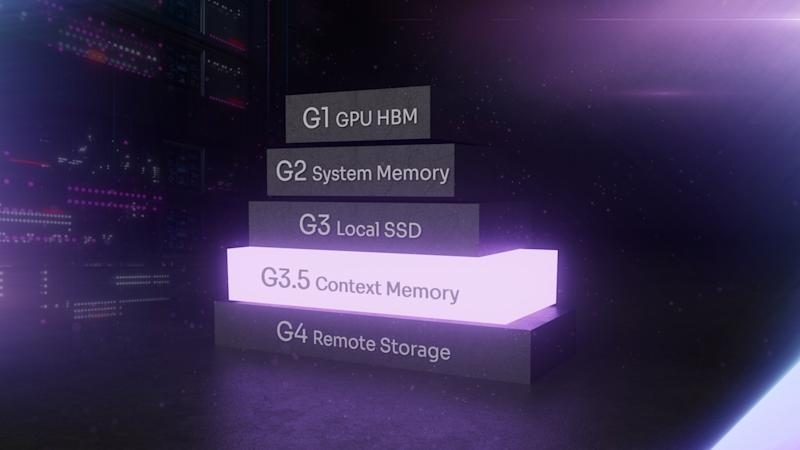
Photo: images.ctfassets.net
Quick answer
AI systems are struggling with memory shortages for context storage as data volumes grow faster than GPU capabilities. The solution is a new context layer between GPUs and storage to enhance performance.
Experts at Solidigm state that by 2026, the key limitation for AI system development will not be GPU compute power but context management. According to Jeff Hartorn, a lead AI researcher at the company, context data volumes are growing faster than GPU capabilities and model efficiency.
Modern AI agents operate across multiple interconnected sessions, where each model call generates a state that must be stored and processed. Enterprises demand that context data be preserved between sessions for auditing, management, and reuse. These factors cause context volumes to exceed the capacity of traditional memory.
The solution involves creating a dedicated context layer between GPU memory and network storage. This layer consists of high-performance SSDs optimized for storing and rapidly accessing key-value (KV) cache and retrieval-augmented data. Nvidia has already formalized this architecture under the name CMX.
Traditional storage systems, designed for AI training, struggle with inference tasks. Training requires sequential writes of large data blocks, whereas inference demands fine-grained, low-latency data access. The new context layer addresses this by ensuring predictable performance and reducing reliance on costly DRAM.
Experts believe that investing in such a storage layer enhances GPU utilization efficiency. Instead of recomputing context, systems gain fast access to stored data, reducing compute resource strain and improving goodput metrics.
Common questions
- Why are GPUs no longer the main bottleneck for AI?
- Modern AI systems require storing vast amounts of context data across sessions. Despite advancements in GPU compute power, context management has become the critical bottleneck for performance.
- What is a context layer in AI infrastructure?
- A context layer is a dedicated high-performance storage tier between GPU memory and traditional storage, optimized for fast access to inference-related context data.
- What storage format is used in the new context layer?
- The context layer utilizes high-density SSDs with predictable latency, optimized for key-value (KV) cache and retrieval-augmented data storage.
Dzen feed: /feed/dzen.xml · RSS: /feed.xml