
Physicist Challenges Microsoft's Quantum Chip Breakthrough Claims
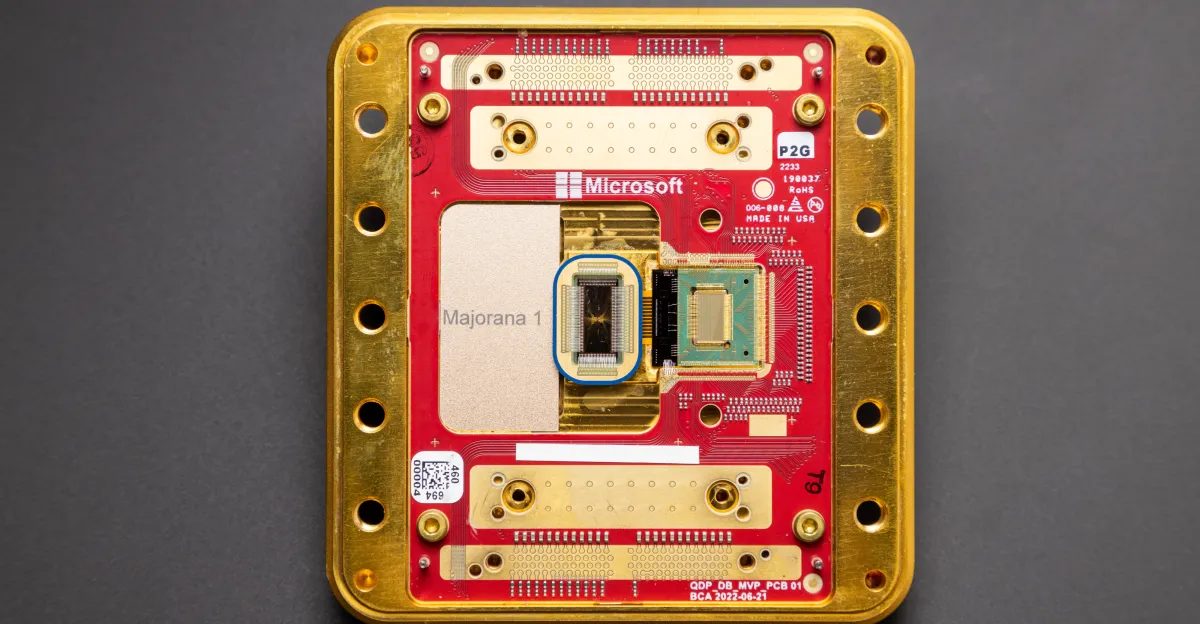
Photo: The Verge
Quick answer
Physicist Henry Legg disputes Microsoft's claims about creating topological qubits based on Majorana particles, asserting that the company's data fails to confirm their existence.
In February 2025, Microsoft announced the creation of the Majorana 1 quantum chip, which the company touted as a breakthrough in topological qubit development. These qubits were positioned as the foundation for future quantum computers, promising greater stability and error resistance compared to competing technologies. However, a new study published in Nature challenges these claims.
Physicist Henry Legg of the University of St Andrews reviewed Microsoft's data and concluded that the company failed to provide compelling evidence for the existence of Majorana particles—the key element required to build topological qubits. Legg argues that observed effects may instead result from quantum dots, which are unsuitable for quantum computing. He also accuses Microsoft of cherry-picking data, undermining the credibility of their findings.
Microsoft responded to the criticism by asserting that Legg's study does not refute their conclusions. Chetan Nayak, Microsoft's quantum computing lead, emphasized the company's confidence in its results and reiterated its commitment to developing a scalable quantum computer by 2029. In June 2025, Microsoft unveiled the Majorana 2 chip, positioning it as the next step toward this goal.
Despite the skepticism, Microsoft remains optimistic, stressing its adherence to scientific rigor. However, widespread doubt within the scientific community could slow progress in this field, particularly if other researchers fail to replicate Microsoft's results. As of now, no existing quantum technology has demonstrated practical viability, and the race to build a functional quantum computer continues.
Common questions
- What are topological qubits, and why are they important for quantum computers?
- Topological qubits are a type of quantum bit designed to be more error-resistant than conventional approaches. This stability could enable scalable quantum computers capable of solving complex problems in medicine, cryptography, and machine learning.
- What criticisms does physicist Henry Legg level against Microsoft?
- Legg argues that Microsoft's data does not prove the presence of Majorana particles in their chips. He suggests observed effects may stem from quantum dots, which are unsuitable for qubit creation, and accuses the company of selective data handling.
- How is Microsoft responding to the criticism?
- Microsoft published a rebuttal in Nature, rejecting Legg's claims and asserting his critique does not invalidate their results. The company reaffirmed its commitment to its roadmap, aiming for a quantum computer by 2029.
Dzen feed: /feed/dzen.xml · RSS: /feed.xml