
Origami Circuits: Paper as the Foundation for Electronics
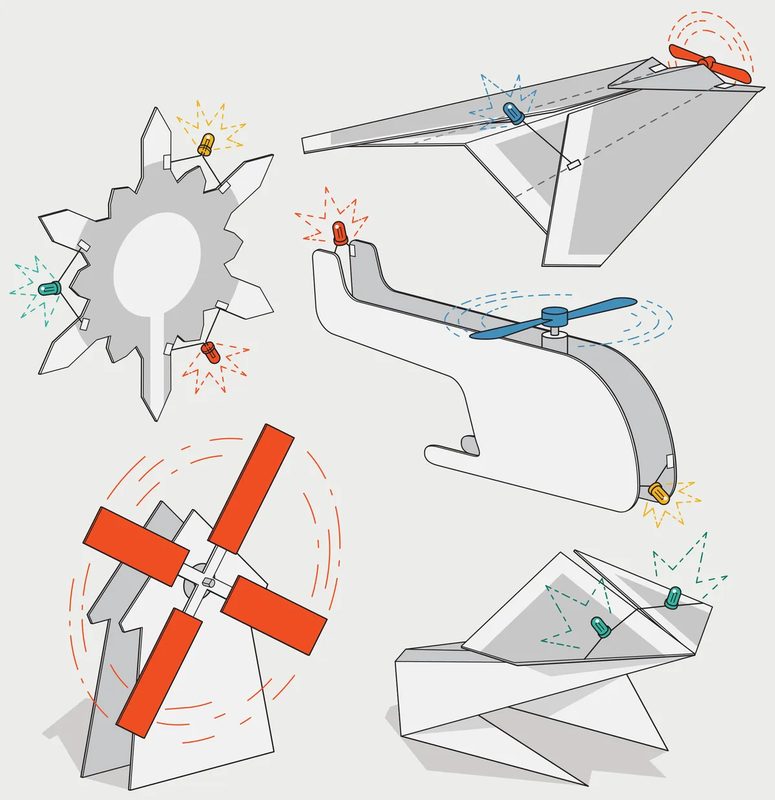
Photo: IEEE Spectrum
Quick answer
The LiqMetCraft technology enables the creation of conductive paper circuits through folding and cutting, using a material infused with gallium-indium liquid metal.
Researchers from the MEI Laboratory at the City University of Hong Kong have unveiled an innovative approach to creating flexible electronic circuits on paper. Instead of relying on traditional methods that require copper tape or other conductive materials, the team proposed using a special paper-like material infused with liquid metal. When subjected to mechanical stress—such as folding or cutting—the surface forms conductive pathways, enabling the integration of electronic components into paper crafts.
The material is a non-woven textile composed of 55% polyester and 45% cellulose, infused with a mixture of isopropanol and a gallium-indium liquid alloy. Initially, the material is non-conductive due to an oxide layer covering the metal droplets. However, when pressure between 2.5 and 100 megapascals is applied during folding or cutting, the oxide layer breaks, allowing adjacent metal particles to connect and form conductive regions. The resistance of these pathways measures 4.4 Ω/cm for folds and 23.18 Ω/cm for cuts.
To simplify the process of creating electronic crafts, the researchers developed the LiqMetCraft toolkit. This includes materials, origami and kirigami templates, and a browser-based app for design and assembly. Users can choose from pre-made designs or create their own, following step-by-step instructions. In testing, 42 participants successfully completed tasks, with some even going beyond the provided templates to create unique projects.
This technology opens new possibilities for educational projects, combining traditional crafts with modern electronics. In the future, researchers plan to experiment with additional materials and expand functionality by enabling the creation of switches and potentiometers directly from paper. This could transform ordinary crafts into interactive devices, making it particularly valuable for STEM education.
Common questions
- How does the paper-based circuit technology work?
- The paper-like material is infused with liquid metal, which is initially non-conductive due to an oxide layer. Folding or cutting breaks this layer, allowing the metal to form conductive pathways.
- What materials are used to create these flexible circuits?
- The base material is a non-woven polyester-cellulose blend infused with isopropanol and a gallium-indium liquid alloy. A small sample costs approximately $1.80 to produce.
- What applications does this technology support?
- The technology is ideal for educational projects, DIY crafts, and prototyping electronic devices. It allows integration of LEDs, motors, and other components into paper structures.
Dzen feed: /feed/dzen.xml · RSS: /feed.xml