
How Honor Lightning Outpaced Competitors in the Robot Marathon Race
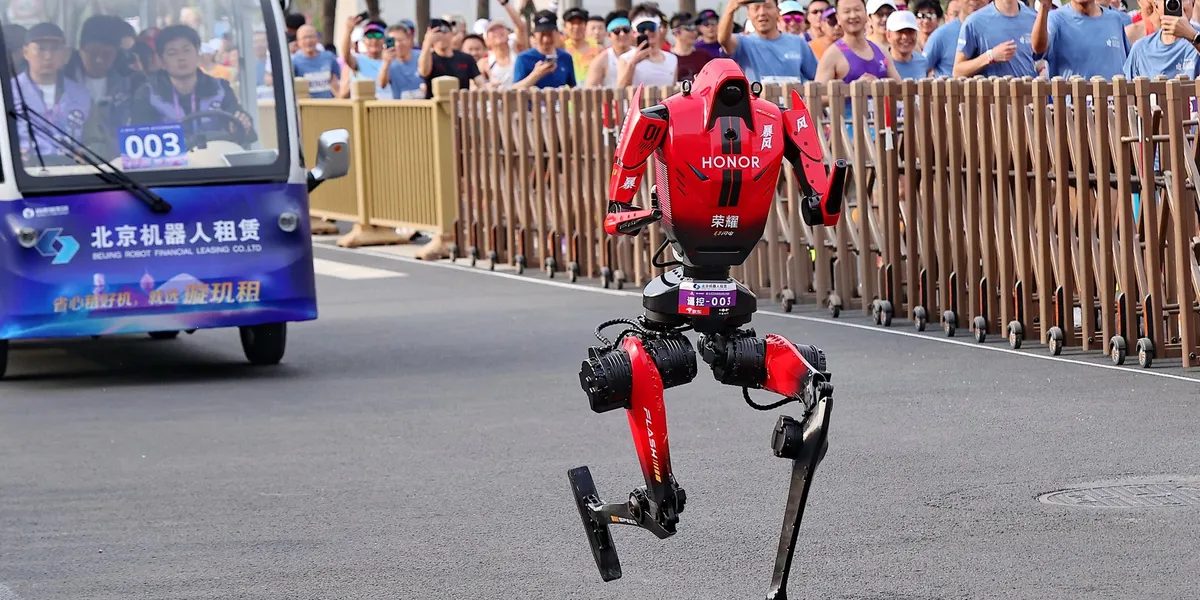
Photo: IEEE Spectrum
Quick answer
Honor Lightning completed a half-marathon faster than humans and other robots by optimizing motor designs and implementing liquid cooling.
Honor has unveiled the Lightning robot, which set a new world record by completing a half-marathon (21.1 km) in 50 minutes and 26 seconds. This is 7 minutes faster than the current human record and nearly two hours ahead of the previous robotic record, set in 2025. The achievement lies not in revolutionary technology but in expert engineering optimization of existing solutions.
The primary challenge for developers is that running is a cyclical process, alternating between the support phase (when the foot pushes off the ground) and the flight phase (when the body moves by inertia). The robot’s motors must deliver high power during push-off while remaining energy-efficient. An optimal gear ratio minimizes energy consumption—for example, a 45:1 ratio is ideal for a speed of 7 m/s (Honor Lightning’s average pace). However, even with this approach, heat output in the knee motors reaches 150 watts—a critical threshold for sustained loads.
The solution was a liquid cooling system integrated into the motors using a capillary-like design. A pump with a flow rate of over 4 liters per minute ensures efficient heat dissipation, maintaining optimal operating temperatures even under prolonged stress. Competitors like Unitree failed to replicate this success because their designs were optimized for walking, not running. Attempting to run with a 30:1 gear ratio (optimal for walking) resulted in heat output exceeding 300 watts per knee motor, requiring additional cooling measures like ice packs.
Experts note that Honor Lightning is not a universal solution but a specialized platform optimized for running. For commercial applications, such as logistics or facility maintenance, a balance between energy efficiency, weight, and versatility is essential. Nevertheless, the technologies introduced could be adapted for robots designed to carry heavy loads or operate in extreme conditions.
Common questions
- What technologies enabled Honor Lightning to set the record?
- The robot utilized motors with an optimal gear ratio (45:1), minimizing energy consumption during running. A key innovation was the liquid cooling system integrated into the motors, capable of dissipating up to 150 watts of heat per knee motor.
- Why couldn’t other robots replicate Honor Lightning’s success?
- Most competitors, including Unitree, optimized their designs for walking rather than running. This led to overheating when attempting high-speed running, as their cooling systems couldn’t handle the heat output of over 300 watts per knee motor.
- Can Honor Lightning’s technologies be applied to commercial robots?
- Yes, but with limitations. Optimizing for running increases weight and energy consumption during walking or standing. Commercial applications require balancing efficiency, weight, and versatility.
Dzen feed: /feed/dzen.xml · RSS: /feed.xml