
How a Frog's Leg Inspired the First Battery
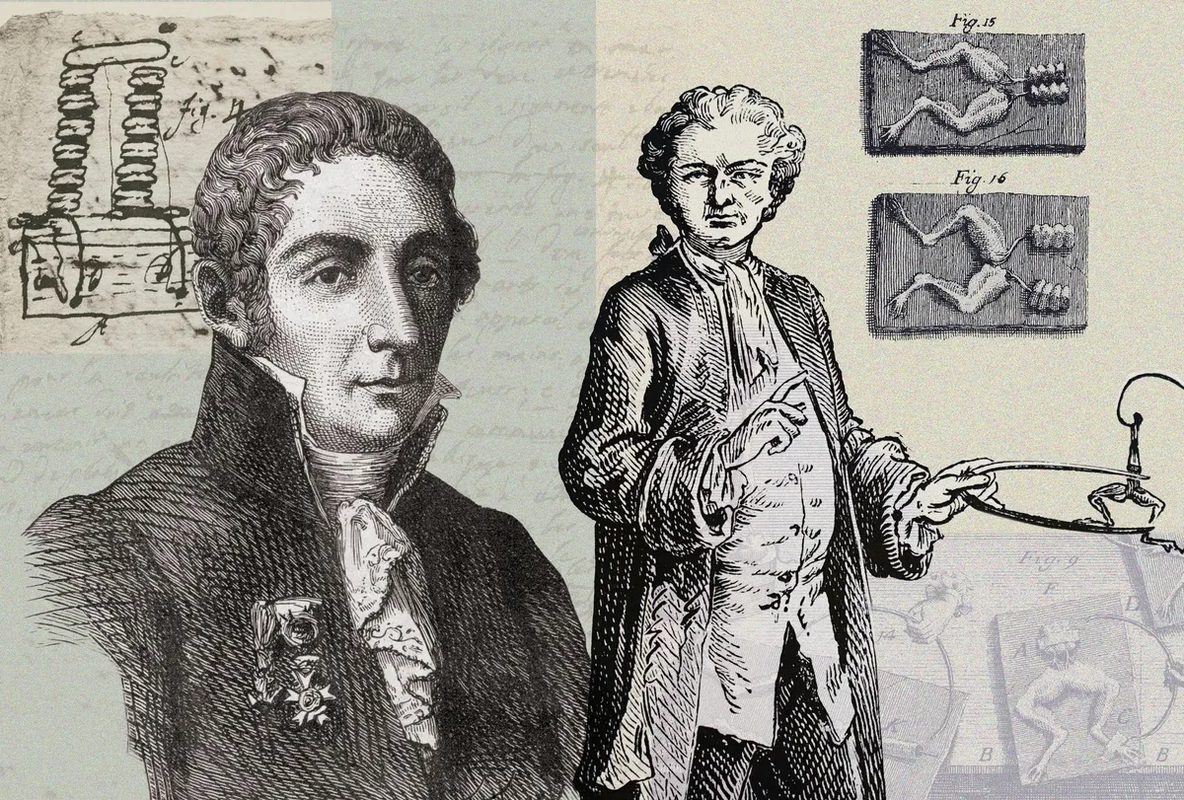
Photo: IEEE Spectrum
Quick answer
In 1799, Alessandro Volta created the first battery prototype, inspired by experiments with dead frogs. This event marked the beginning of modern electrochemistry and energy systems.
In the late 18th century, the scientific world was gripped by a debate over the nature of electricity. Italian physicist Alessandro Volta and his colleague Luigi Galvani engaged in a lively discussion that ultimately led to the creation of the first battery. Galvani, a renowned physician, conducted experiments with dead frogs, observing their muscle contractions under the influence of electric current. He was convinced that living organisms possessed a unique 'animal electricity.'
Volta, however, rejected this theory. He proved that the source of electricity in Galvani's experiments was not biological processes but the contact between two different metals and a moist environment. In 1799, Volta assembled the first battery prototype, consisting of alternating copper and zinc discs separated by fabric soaked in saltwater or acid. This device, called the voltaic pile, generated a steady electric current through a chemical reaction.
Volta's discovery revolutionized science. Just six weeks after its demonstration, British scientists William Nicholson and Anthony Carlisle used the voltaic pile to electrolyze water, splitting it into hydrogen and oxygen. Later, Humphry Davy employed an advanced version of the battery to isolate several chemical elements, including potassium and sodium. Despite the limited lifespan of early batteries, their invention laid the groundwork for the development of electrochemistry and energy systems.
The debate between Volta and Galvani not only shaped modern understanding of electricity but also inspired writers. In 1818, Mary Shelley published the novel Frankenstein, referencing Galvani's experiments as a possible inspiration for the idea of reanimating the dead. Today, the voltaic pile is preserved in the Royal Institution of Great Britain's museum as a symbol of the dawn of a new scientific era.
Common questions
- Who created the first battery?
- The first battery prototype, called the voltaic pile, was invented by Italian physicist Alessandro Volta in 1799.
- What discovery preceded the battery?
- Luigi Galvani's experiments with electrical phenomena in dead frogs during the 1770s served as the starting point for Volta's research.
- What was the significance of Volta's invention?
- The voltaic pile became the foundation for electrochemistry development, and its invention initiated modern energy systems.
Dzen feed: /feed/dzen.xml · RSS: /feed.xml