
How LinkedIn, Walmart, and Zendesk Overcame Infrastructure Barriers for AI Agents
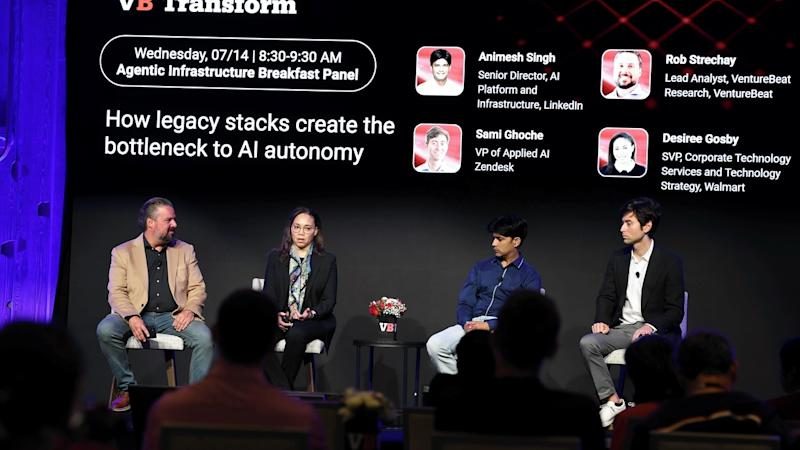
Photo: images.ctfassets.net
Quick answer
LinkedIn, Walmart, and Zendesk encountered infrastructure limitations when deploying AI agents. Legacy systems, unoptimized for agent speed, created critical bottlenecks.
At VB Transform 2026, representatives from LinkedIn, Walmart, and Zendesk shared key insights on the obstacles to AI agent adoption. The primary challenge wasn’t model performance but infrastructure ill-suited for agent speed. Systems originally designed for human interaction fail to meet millisecond latency requirements.
LinkedIn faced Kubernetes limitations, where dynamic container allocation took seconds—far too slow for AI agents. The solution involved pre-configured container pools that instantly switch between workloads. The company also revamped orchestration: instead of using one LLM to evaluate another, it implemented deterministic processes where 80% of logic runs as scripts, with models reserved for reasoning tasks.
Walmart encountered an unexpected issue: its internal AI agent tool became so popular that employees began building redundant solutions. Rather than restricting access, the company introduced a management system that automatically identifies duplicates, selects the best versions, and integrates them into production without engineering intervention. Zendesk, meanwhile, abandoned the idea of loading 20 billion customer interactions into broad-context LLMs. Instead, it invested in modernizing its data infrastructure to ensure more accurate and efficient agent interactions.
All three companies agreed that the key to success lies in model and provider independence. LinkedIn created a universal gateway for model interactions, Walmart adopted a flexible architecture for diverse workloads, and Zendesk prioritized ownership of its infrastructure. Experts recommend starting with evaluation systems, deploying tools early for employees, and building architectures independent of models and context.
*** LinkedIn is banned in the Russian Federation.
Common questions
- Why does legacy infrastructure slow down AI agents?
- Traditional systems were built for human interaction, where delays of several seconds are acceptable. AI agents operate in millisecond ranges, requiring fundamentally different architectural approaches.
- What solutions helped LinkedIn accelerate AI agent performance?
- LinkedIn shifted from dynamic container allocation to pre-configured pools and implemented deterministic workflows, reducing LLM usage by 80% to minimize hallucination risks.
- How did Walmart handle AI agent duplication?
- The company deployed a management system that automatically detects duplicates, selects the best versions, and integrates them into production without engineering delays.
- Why did Zendesk abandon direct data loading into LLMs?
- Transferring 20 billion customer interactions with broad context proved inefficient. Zendesk instead modernized its data infrastructure for precise agent interactions.
Dzen feed: /feed/dzen.xml · RSS: /feed.xml