
Moonshot AI Unveils Kimi K2.7-Code: 30% Token Reduction with Benchmark Concerns
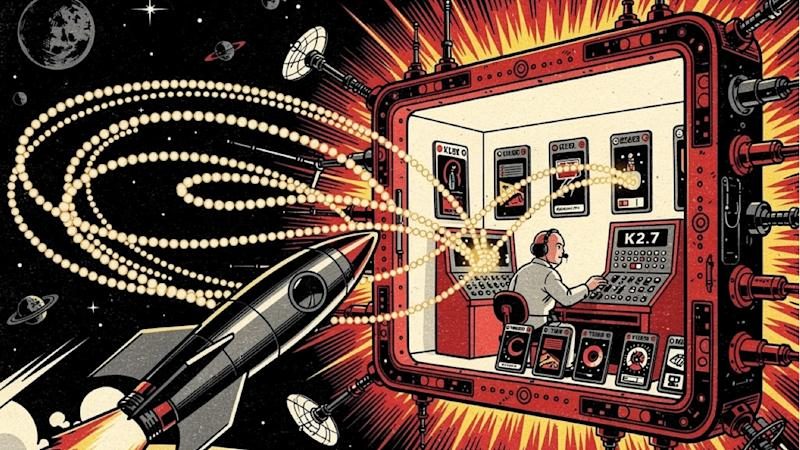
Photo: images.ctfassets.net
Quick answer
Moonshot AI launched Kimi K2.7-Code with a claimed 30% token reduction and performance improvements, but independent tests reveal inconsistent results.
Chinese AI startup Moonshot AI has unveiled an updated version of its code generation model, Kimi K2.7-Code. The company claims the new model reduces "thinking" token consumption by 30% compared to its predecessor, K2.6, potentially lowering inference costs in agentic workflows. Built on the same trillion-parameter Mixture of Experts architecture, the model is released under the Modified MIT license, with weights available on HuggingFace.
K2.7-Code differs from K2.6 in its code generation approach: while K2.6 relied on wrappers over existing libraries, the new model writes implementations directly. According to Moonshot AI, this improves generalization across Rust, Go, and Python, as well as efficiency in frontend development, DevOps, and performance optimization tasks. However, the model operates exclusively in "thinking" mode with a fixed temperature of 1.0, preventing deterministic output customization.
On Moonshot AI's internal benchmarks, the model demonstrates performance gains: 21.8% on Kimi Code Bench v2, 11% on Program Bench, and 31.5% on MLS Bench Lite. Independent researchers, however, have questioned the objectivity of these results. Developer Elliot Arledge tested the model on KernelBench-Hard and found that while K2.7-Code generates more "honest" code, it is not always correct: two out of six Triton kernels failed, and one result underperformed compared to K2.6.
Experts stress the need for independent evaluations, such as DeepSWE, which provides a broader performance spread across models. Developer Sugumaran Balasubramanian, creator of a task router for the Hermes Agent platform, noted that K2.6 achieved a 24% score on DeepSWE, comparable to GPT-5.4-mini, and urged Moonshot AI to release K2.7-Code's results on the same benchmark.
For enterprises, the update may offer benefits: OpenAI-compatible API integration allows teams to replace K2.6 with K2.7-Code without infrastructure changes. However, extensive testing on custom tasks is recommended before large-scale deployment to assess real-world cost savings and performance.
Common questions
- What is Kimi K2.7-Code?
- An updated open-source code generation model from Moonshot AI, optimized for reduced token usage and improved performance. It supports Rust, Go, and Python but does not allow deterministic output customization.
- Why are Kimi K2.7-Code benchmarks controversial?
- Moonshot AI's internal tests show significant gains, but independent researchers report modest or even worse results on third-party benchmarks compared to its predecessor, K2.6.
- How can Kimi K2.7-Code be integrated into workflows?
- The model is OpenAI API-compatible and supports deployment via vLLM or SGLang. Teams using K2.6 can replace it without infrastructure changes, though testing on custom tasks is recommended.
Dzen feed: /feed/dzen.xml · RSS: /feed.xml