
Why Your 10,000mAh Power Bank Won’t Charge Your Smartphone Twice
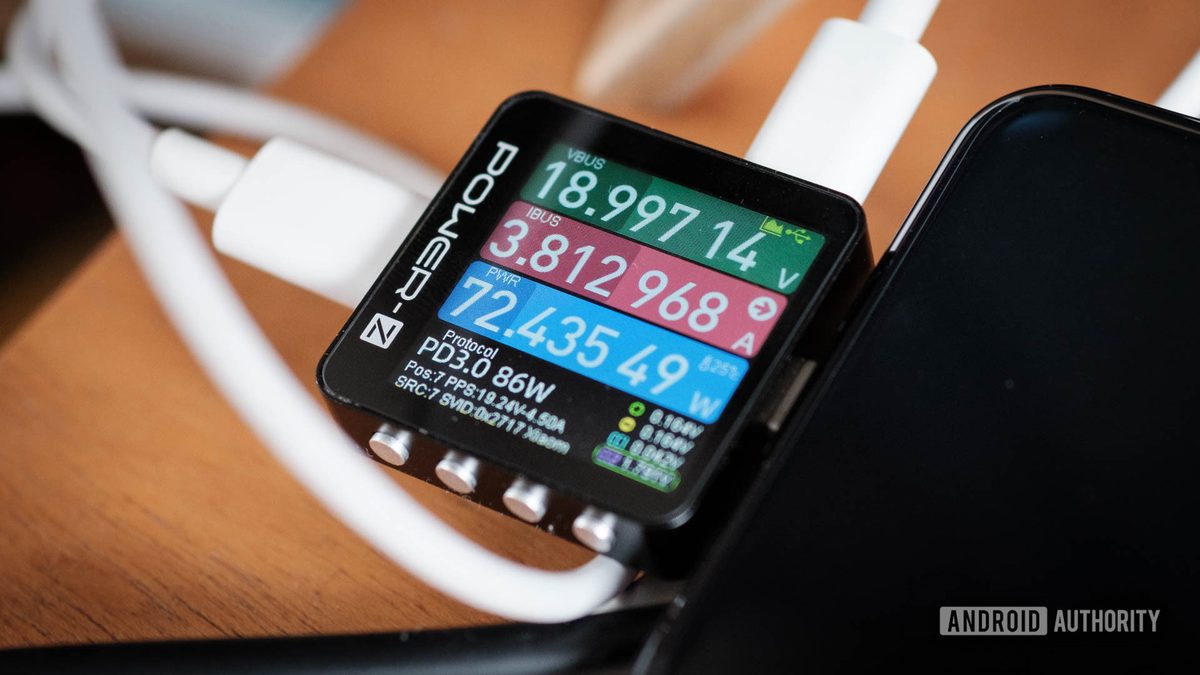
Photo: Android Authority
Quick answer
Power banks fail to deliver their claimed capacity due to energy losses during voltage conversion, battery and cable resistance, and inefficiencies in charging circuits.
Manufacturers of power banks list capacity in milliampere-hours (mAh), but this figure does not reflect the actual amount of energy the device can deliver to your smartphone or laptop. The reason is that mAh is a relative value dependent on the battery’s nominal voltage, which is typically 3.7–3.85V for lithium-ion batteries. However, charging devices requires higher voltages: 5V for USB, 9V for fast charging, or 20V for laptops.
To understand a power bank’s real capacity, you need to convert mAh to watt-hours (Wh) by multiplying the mAh value by the nominal voltage. For example, a 10,000mAh battery with a 3.7V voltage has a capacity of 37Wh. However, when converting voltage to 5V or higher, some energy is lost due to inefficiencies in circuits and heat. Typical losses range from 10–30%, depending on component quality and charging conditions.
Additional losses occur due to battery and cable resistance, especially at high currents. For instance, charging a 100W laptop with a cheap cable can result in several percentage points of loss. Wireless charging is even less efficient: even modern standards like Qi2 lose up to 20% of energy due to coil heating and air resistance. As a result, the actual output of a power bank rarely exceeds 70–90% of the claimed capacity.
To avoid disappointment, experts recommend choosing power banks with a capacity buffer. For example, to fully charge a smartphone with a 5,000mAh battery, it’s better to use a 6,700–7,000mAh power bank. For extended trips, models with a capacity of 70Wh or higher are optimal, allowing you to charge multiple devices without significant power loss.
Common questions
- Why won’t a 10,000mAh power bank charge a smartphone twice?
- The claimed capacity in mAh is specified at the battery’s nominal voltage (typically 3.7V), not the charging voltage (5V or higher). Losses during voltage conversion and component resistance reduce the actual output to 70–90% of the stated capacity.
- How can I calculate the real capacity of a power bank?
- Multiply the capacity in mAh by the battery’s nominal voltage (e.g., 10,000mAh × 3.7V = 37Wh). Then, convert this value to mAh for your device by considering its charging voltage.
- Why is wireless charging less efficient?
- Wireless charging loses up to 20% of energy due to coil heating and air resistance. Even modern standards like Qi2 do not fully resolve this issue.
Dzen feed: /feed/dzen.xml · RSS: /feed.xml