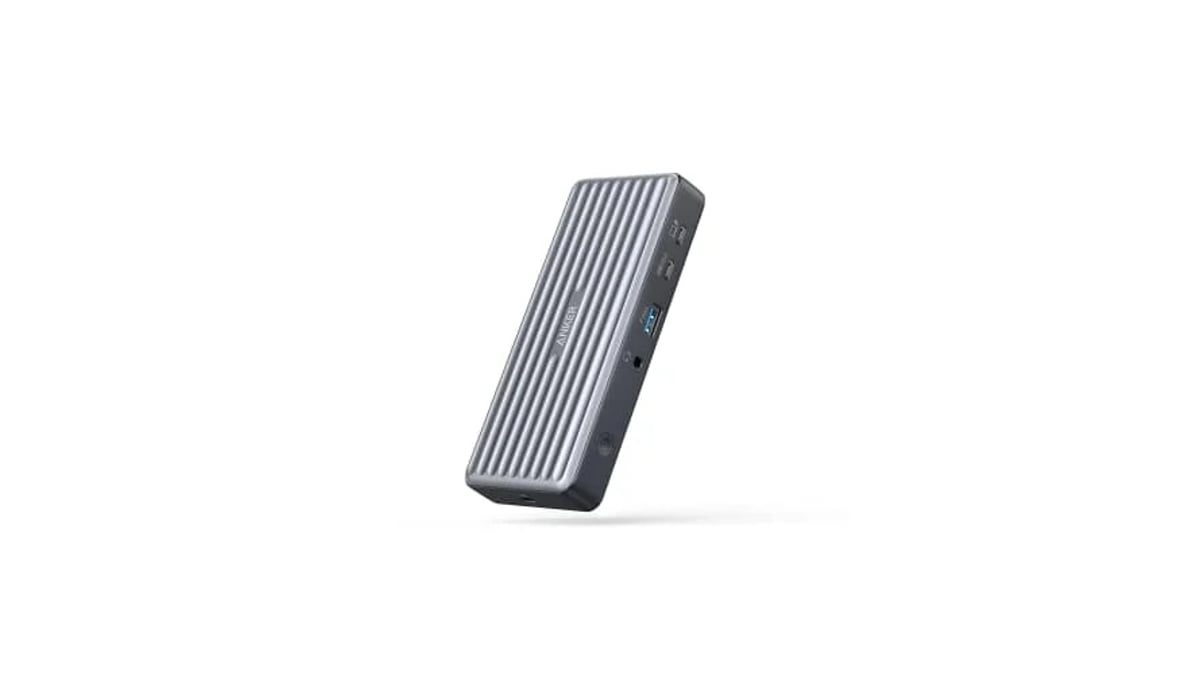
A lucrative offer has hit the market for users looking to optimize their workspace: the Anker PowerExpand 9-in-1 docking station is now available at a 40% discount, reducing its price to 5000 ₽ The device supports multiple peripherals, including 4K monitors, USB accessories, and network cables, making it a versatile solution for laptop and desktop PC owners.
Anthropic, a leading generative AI developer, is preparing to release its experimental Claude Mythos model, despite significant security risks to corporate and government IT systems. First announced in April, the model has been flagged for potential threats to software stability, though its specific risk mechanisms remain undisclosed. Internal sources suggest Mythos may integrate with the Claude Code ecosystem, raising cybersecurity concerns. Access will likely be restricted to a limited user base with enhanced controls. While Anthropic has not confirmed a release timeline, preparations are underway. Experts warn that large-scale deployment of Mythos could require stringent safeguards, particularly in critical infrastructure sectors.
The Early Bird discount for TechCrunch Disrupt 2026 will expire in just five days. Organizers are offering up to 29 195 ₽ off tickets, but the deal ends on May 29. The event will take place in San Francisco from October 13–15, gathering over 10,000 attendees, including startup founders, investors, and industry experts. This is a unique opportunity for networking, securing funding, and exchanging insights with leaders in the tech sector.
The gay and bisexual dating app market is undergoing a transformation as new services emerge to address privacy concerns and data monetization issues plaguing established platforms. These startups are redefining online dating by emphasizing decentralized architectures, end-to-end encryption, and transparent algorithms. Their goal is not only to compete with industry giants like Grindr but to establish a more ethical and secure interaction model. By giving users greater control over their data and reducing reliance on invasive tracking, these apps aim to build trust in an ecosystem often criticized for exploitative practices.
The IEEE TryEngineering OnCampus program, aimed at engaging students early in engineering disciplines, expanded from two to seven universities worldwide last year. Supported by IEEE Educational Activities and the IEEE Innovation Committee, the initiative offers hands-on workshops for students aged 10–18 in cutting-edge fields like artificial intelligence, robotics, quantum computing, and IoT. The projects are hosted at leading universities across Europe, Asia, and Africa, where students not only learn theory but also tackle real-world challenges under expert guidance.
At the ISCAS 2026 conference in Shanghai, Huawei’s board director He Tingbo unveiled Tau Law, a groundbreaking semiconductor scaling concept. The new approach leverages logic folding and temporal optimization to bypass Dennard scaling constraints, enabling transistor density equivalent to a 1.4nm process by 2031. This breakthrough could redefine high-performance computing and energy-efficient solutions across industries, offering unprecedented scalability for AI, cloud computing, and mobile devices.
The U.S. government has allocated billions to quantum technologies, including the nation’s first quantum foundry. Legal and business experts warn these initiatives may violate antitrust laws by creating unequal conditions for private players, undermining fair competition. While proponents argue the move is critical for national security and economic growth, critics highlight risks of monopolization by state-backed entities or contracted firms. The debate remains unresolved, demanding rigorous legal scrutiny as private quantum firms may pursue litigation. Without such support, however, U.S. risk falling behind rivals like China and the EU in quantum advancements.
Lucra Sports, a startup offering interactive gaming tournaments as a business loyalty tool, successfully raised 1,4 млрд ₽ in a Series B round despite the dominance of AI in venture capital. Founder Dylan Robbins revealed two key tactics that helped overcome investor skepticism and secure backing from ARK Invest, a fund that had previously lost money on a similar project. The strategies included leveraging personal connections and adapting the pitch to align with market trends, positioning the startup as a smart diversification play.
The deadline to apply for Startup Battlefield 200 is approaching fast. This prestigious program offers early-stage startups a unique opportunity to showcase their innovations on a global stage, attract venture capital, and secure 7,2 млн ₽ in funding without giving up equity. Organized by TechCrunch, the competition targets pre-Series A companies ready to pitch their potential to an audience of 10,000 attendees, top investors, and media outlets. Past winners include Dropbox, Cloudflare, and Discord, proving that even minimal prototypes can disrupt industries. With 200 selected startups and 20 finalists, participants gain three days of exhibition space, free team passes, pitch training, and masterclasses from leading VCs. The program has a track record of over 1,700 participants raising 2,3 трлн ₽ in total funding and achieving 250+ exits, including acquisitions by Microsoft, Google, and Amazon.
The U.S. Federal Trade Commission (FTC) has levied a 66,2 млн ₽ fine against Cox Media Group and two marketing firms—MindSift and 1010 Digital Works—for misleading customers about their ability to monitor conversations via smartphone microphones for targeted advertising. The investigation revealed that the Voice Data system, heavily promoted in 2023 with Black Mirror-like comparisons, lacked the technical capability to perform such surveillance. Instead, marketers resold third-party data, including email lists, at inflated prices. The FTC confirmed the system never used voice data or provided accurate geotargeting as promised, while also violating consent laws by falsely claiming user approval for data collection.
A leading Japanese university is integrating Google AI Pro for Education to streamline workflows. The platform will be available to 10,000 faculty and administrative staff, accelerating routine tasks. Supported by Google Cloud Japan, the project aims to boost operational efficiency in education. Similar AI solutions in top U.S. and European universities have reduced administrative time by up to 40%.
At a recent event in Wuhan, GigaAI unveiled its groundbreaking 'Dual Pyramid' architecture, engineered to address critical challenges in embedded artificial intelligence. Positioned as the world's first physical AGI architecture, the system aims to eliminate data and algorithmic bottlenecks that have historically constrained robotics and autonomous system development. This innovation represents a pivotal step toward scalable, intelligent devices capable of real-world interaction and adaptation.





 Hardware